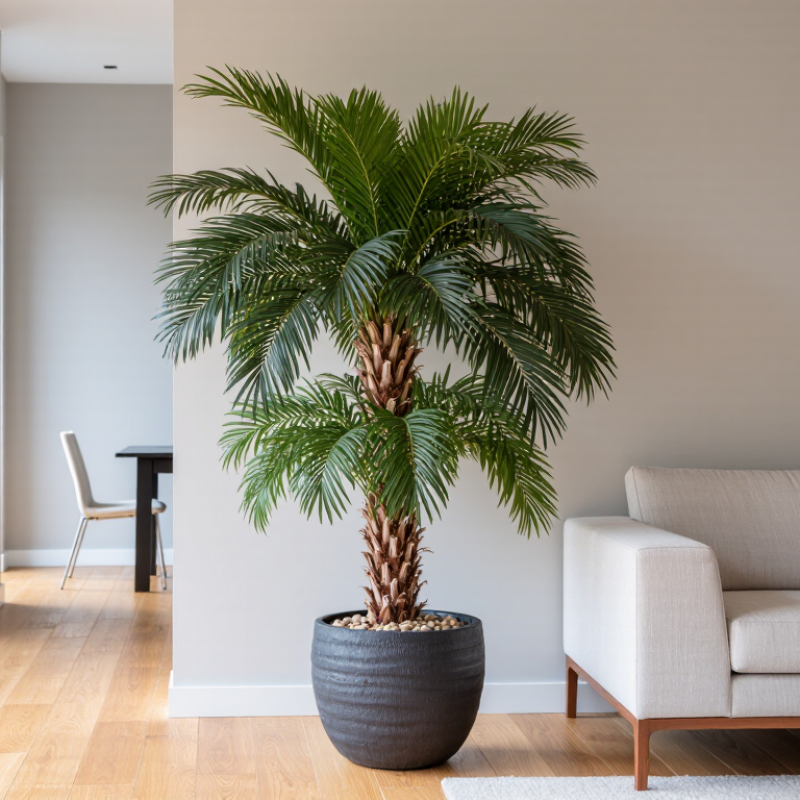
10 Tips for Buying a Giant Fake Plant?

Time:2026-10-21 Author:Madeline
0%

Buying a Giant Fake Plant can transform a dull corner, but size alone does not create a convincing display. A towering artificial palm may look impressive online, then overwhelm a low-ceilinged room. These ten practical tips will help you judge proportion, materials, construction, and long-term value before purchasing.

Sally Augustin, PhD, an environmental psychologist known for her work on design and wellbeing, observes, “Plants can make people feel calmer and more comfortable.” That idea matters, even when the plant is artificial. A realistic Giant Fake Plant should support the room’s mood without becoming a plastic focal point. Examine leaf color under natural light. Check whether stems bend naturally. Look closely at the pot, because a lightweight base may tip beside a doorway.

Material quality matters. Polyester leaves often feel softer, while plastic can offer stronger structure and easier cleaning. However, neither material guarantees realism. Dust gathers quickly on broad leaves. A slightly imperfect surface may look more natural than a flawless, glossy finish.

Measure the ceiling, walking space, and furniture height first. Leave enough room to clean around the pot. Consider UV-resistant materials for sunrooms, but do not assume every “outdoor” label promises years of color stability. Ask about warranties, assembly, shipping damage, and replacement parts.

The cheapest option may not be the best value. Nor is the most expensive automatically convincing. Compare photographs carefully. Read recent reviews. Notice what sellers avoid showing.

A Giant Fake Plant should feel intentional, not merely large. There is room for personal taste, and some choices may still disappoint. That is part of the buying process. Reconsider the scale before placing the order.

10 Tips for Buying a Giant Fake Plant?

Measure Fit: Compare Plant Height, Canopy Width, and Ceiling Clearance

10 Tips for Buying a Giant Fake Plant?

Measure the plant before admiring its leaves. Record total height, canopy width, pot diameter, and ceiling clearance. The National Gardening Association’s 2024 survey reports that indoor-plant spending remains a multibillion-dollar category, showing how strongly people value indoor greenery. Artificial plants need similar planning, even without watering. A large canopy can block lighting, artwork, vents, or walking routes. Measure twice. I still misjudged a doorway once.

Tip: Leave at least 15–30 centimetres between the tallest leaf and the ceiling. This gap prevents a cramped appearance and allows gentle leaf adjustment. Compare the listed height with the real assembled height, including the planter. A 210-centimetre tree may exceed that measurement after its branches open.

Check canopy width from several angles. Manufacturers often provide one average width, not the widest spread.

Tip: Mark the floor with painter’s tape before ordering. Create a rectangle matching the pot footprint, then extend tape around the expected canopy. Walk past it with a basket, chair, or suitcase. The 2024 Houzz & Home Study continues to identify functionality as a major renovation priority, so visual drama should not reduce daily access.

In narrow rooms, choose a taller, slimmer silhouette. In open rooms, a broader canopy may anchor an empty corner. Room photos can deceive. Real measurements are less forgiving, but far more reliable.

Evaluate Construction: Compare PE, PVC, Polyester, Pot Weight, and Leaf Density

Tip: Start with the leaves, but inspect the stems too. PE leaves usually feel thicker and more realistic than PVC leaves. They often show gentle veins, soft edges, and slight color variation. PVC can cost less, but it may look shiny under direct lighting. Polyester leaves are flexible and lightweight, although thin fabric can crease or fade near sunny windows. Bend several leaves carefully. They should return to shape without exposing loose wires.

Tip: Check leaf density from different angles. A giant plant should not look full only from the front. Look through the canopy and inspect empty gaps around the central stem. Dense foliage hides the support structure, but excessive leaves can make the plant look crowded. I once preferred a cheaper model because it looked full online. In person, the sparse side was obvious. Photos can mislead.

Tip: Do not ignore pot weight. A tall plant with a light plastic pot may wobble when a door opens or a child brushes past it. Test the base on a hard floor and gently press the upper leaves. A heavier inner pot improves stability, while a weighted planter adds confidence. Still, weight alone proves little. Check whether the stem is firmly fixed inside the pot. Some fillers settle over time. That detail is easy to miss. Look for a level base, clean seams, and secure joints before buying.

10 Tips for Buying a Giant Fake Plant? — Evaluate Construction: Compare PE, PVC, Polyester, Pot Weight, and Leaf Density

Tip Construction Factor What to Inspect Typical Data or Benchmark Preferred Option Main Trade-Off
1 Define the required height Measure the ceiling height, doorway width, elevator clearance, and available floor area before ordering. Leave approximately 15–30 cm of clearance below the ceiling. Many “giant” artificial plants are about 180–300 cm tall. Choose a plant that fits without bending, compressing, or blocking walkways. Larger plants create more visual impact but are harder to transport and reposition.
2 Compare leaf materials Check whether leaves are made from polyethylene (PE), polyvinyl chloride (PVC), polyester fabric, or a combination. PE is commonly used for molded, textured leaves; PVC is flexible and economical; polyester is often fabric-based and highly shapeable. Select UV-treated PE or a PE/PVC combination for a more structured appearance and regular indoor use. More realistic molded materials may cost more and can be less flexible during shipping.
3 Evaluate PE leaf quality Look for molded veins, varied shades of green, natural edge contours, and a matte rather than mirror-like surface. High-quality molded PE leaves usually have visible surface texture and multiple color tones instead of one uniform color. Choose leaves with asymmetry, tonal variation, and realistic central veins. Textured PE can appear more realistic but may feel firmer than fabric leaves.
4 Check PVC flexibility Bend several leaves and stems gently. Inspect for brittleness, whitening at bends, strong plastic odor, or thin edges. PVC leaves should flex without cracking or permanently whitening. Very thin PVC may look flat and can deform under heat. Use medium-thickness PVC for flexible secondary foliage and accent leaves. PVC is generally economical and flexible, but low-quality material may look shiny or plasticky.
5 Assess polyester foliage Examine the fabric weave, printed detail, stitched or sealed edges, and resistance to creasing. Polyester leaves are lightweight and easy to reshape, but exposed fabric can collect dust more readily than smooth molded plastic. Choose polyester when soft movement, low weight, and easy reshaping are more important than rigid leaf texture. It may provide a softer appearance but can show fraying, folds, or fading if poorly finished.
6 Measure leaf density Count the visible leaves, inspect gaps from several angles, and check whether the internal frame can be seen. For a full-looking giant plant, approximately 150–300 leaves is a useful general range, depending on leaf size and plant type. Choose layered foliage with visible depth, varied leaf directions, and limited empty space around the trunk. Higher density improves fullness but increases weight, dusting time, and shipping volume.
7 Inspect the internal frame Check whether the main stem contains a rigid metal or fiberglass support and whether branches are securely attached. A tall plant should not wobble excessively when lightly touched. Flexible branch wires should hold their adjusted position. Prefer a reinforced central stem with bendable but firm branch connections. A stronger frame improves stability but can make the plant heavier and less convenient to reshape.
8 Compare pot weight Ask whether the planter contains cement, sand, gravel, plaster, or another weighted filler beneath the surface. For a 180–240 cm indoor plant, a total base weight of roughly 8–20 kg is a practical stability range, depending on plant width and center of gravity. Select the heaviest base that can still be safely moved through the intended doorway and floor area. A heavier pot reduces tipping risk but increases delivery, handling, and floor-load considerations.
9 Review UV and fire properties Look for documented UV resistance and, where required by the building, tested flame-retardant performance. UV resistance slows fading but does not make foliage permanently colorfast. Flame-retardant claims should identify a recognized test standard. Choose UV-treated materials for bright rooms and request compliance documentation for commercial interiors. Special treatments may increase cost and still require protection from prolonged direct sunlight or heat.
10 Check maintenance and delivery details Confirm assembly requirements, cleaning method, packed dimensions, return conditions, and whether the pot arrives separately. Smooth PE and PVC can usually be dusted with a soft cloth; polyester may require gentler vacuuming or low-moisture cleaning. Choose a partially assembled plant with detachable or adjustable branches when access and maintenance are concerns. Convenient assembly and lighter packaging may require more setup and branch shaping after delivery.

Note: Weight, height, leaf count, and material performance vary by plant shape, leaf size, frame design, and pot construction. Use the stated ranges as practical comparison guidelines rather than universal specifications.

Verify UV Resistance: Check ASTM G154 Testing at 60°C UV Exposure

10 Tips for Buying a Giant Fake Plant?

A giant artificial plant may look convincing indoors, yet sunlight can expose weak materials quickly. Check the supplier’s UV-resistance evidence, not just the phrase “outdoor safe.” ASTM G154 describes fluorescent ultraviolet exposure procedures for plastics and coatings. A commonly referenced cycle uses UV exposure near 60°C black-panel temperature, followed by condensation. This temperature matters because heat can accelerate fading, cracking, and brittle leaves.

Tip: Ask for the exact ASTM G154 cycle, exposure hours, lamp type, irradiance, and color-change results. ISO 4892-3 also provides guidance for fluorescent UV testing. These standards describe test methods, not automatic product certification. A reliable seller should identify the tested material, such as the leaf film, stem coating, or pot surface. Testing only a small sample may not represent the finished plant. That detail is easy to miss.

Look closely at the leaves. Bend one gently. A good UV-stabilized leaf should recover without whitening or sharp creases. Inspect seams around stems, where sunlight and moisture often attack first. Technical reports from materials testing laboratories commonly compare color change using ΔE values; lower change generally indicates better color retention. However, laboratory hours do not equal a fixed number of outdoor years. Local heat, window glass, humidity, and facing direction alter performance. My practical mistake was trusting a “UV protected” label without requesting the test report. It looked reasonable. It was not enough. Choose documented exposure data over attractive wording.

Assess Fire Performance: Request ASTM E84 Class A Test Documentation

When buying a giant fake plant, assess fire performance before judging its leaves or height. Ask the supplier for ASTM E84 Class A test documentation. This test measures surface flame spread and smoke development, not complete fire resistance.

Class A generally means a flame-spread index of 0–25 and a smoke-developed index of 0–450. Verify these values in the original laboratory report.

The document should identify the exact materials tested, including leaves, stems, coatings, backing, and pot components. A report for a small decorative sample may not represent a two-meter plant with dense polyester foliage.

Request the laboratory name, test date, specimen thickness, mounting method, and report number.

Check whether the tested construction matches the product delivered.

Details matter.

The National Fire Protection Association reported 1,504,500 U.S. fires and approximately 18.1 billion dollars in property damage during 2022. That context makes decorative fire safety more than paperwork.

In practice, keep oversized plants away from heaters, candles, electrical panels, and exit routes. Inspect dry or brittle foliage, loose wiring, and hidden foam fillers.

Class A is reassuring, but it is not a magic shield. I would still question vague “fire retardant” claims without test evidence. A rushed purchase can reveal a gap in my judgment.

Calculate Value: Compare Price per Height, Warranty, and Expected Service Life

A giant fake plant should be priced by usable height, not visual drama. Measure from the floor to the highest leaf, then divide the purchase price by inches. A $180, 72-inch tree costs $2.50 per inch. A $140, 48-inch tree costs $2.92. The cheaper checkout total is not always better value. Grand View Research’s 2024 Artificial Plants Market report indicates continued market growth, but rising demand does not guarantee better construction.

Check the warranty carefully. Look for coverage of fading, broken stems, loose leaves, and pot damage. A twelve-month warranty may exclude sunlight, moisture, or commercial use. Those exclusions matter near a bright window. ASTM G154 is commonly used for accelerated UV exposure testing, although a test result does not promise identical home performance. Ask for the test duration and material details.

Expected service life should include maintenance. Dust every few weeks, avoid bending cold stems, and use a stable pot in busy walkways. Industry product studies often describe artificial foliage as lasting five to ten years indoors, while direct sunlight can shorten that period. Treat this as an estimate, not a guarantee. I still get this calculation wrong when appearance wins. Add delivery, replacement pots, and storage space to the real cost. A one-year warranty can be poor value if the plant costs twice as much as a similar model with five-year coverage.

10 Tips for Buying a Giant Fake Plant: Calculate Value

Compare estimated price per foot of height, warranty coverage, and expected service life before choosing a large artificial plant.

The figures represent typical market ranges for generic artificial plants sold for indoor or sheltered commercial use. A lower price per foot, longer warranty, and longer expected service life generally indicate better long-term value.

FAQS

How can I verify a giant artificial plant’s UV resistance?

Ask for the exact ultraviolet test cycle, exposure hours, lamp type, and color-change results. Look for evidence. The report should identify the tested leaf film, stem coating, or pot surface.

Does a UV test guarantee years of outdoor color retention?

No. Laboratory exposure does not equal a fixed number of outdoor years. Heat, humidity, window glass, and facing direction affect fading. I once trusted a “UV protected” label. That was not enough.

What should I inspect on the leaves before buying?

Bend one leaf gently and check whether it recovers without whitening or sharp creases. Inspect stem seams closely. Sunlight and moisture often damage those areas first.

What fire-performance documents should I request?

Request an original laboratory report showing surface flame spread and smoke-development results. Confirm the tested materials include leaves, stems, coatings, backing, and pot components. A tiny sample may not represent a dense, two-meter plant.

Does a high fire-safety class make the plant completely fireproof?

No. It only describes specific test performance. Keep the plant away from heaters, candles, electrical panels, and exit routes. A reassuring label is not a magic shield.

How can I compare the real value of different artificial plants?

Measure floor-to-leaf height, then divide the price by that measurement. For example, a $180, 72-inch plant costs $2.50 per inch. The lower checkout price may still offer worse value.

What warranty details deserve close attention?

Check whether the warranty covers fading, broken stems, loose leaves, and pot damage. Look for exclusions involving sunlight, moisture, or commercial use. Small wording matters.

How long might a giant artificial plant last indoors?

Many indoor plants may last roughly five to ten years with regular care. Direct sunlight can shorten that period. Dust the leaves every few weeks and avoid bending cold stems. This remains an estimate, not a promise.

Conclusion

Buying a Giant Fake Plant requires more than choosing the tallest option available. Start by measuring the intended space, including the plant’s height, canopy width, and available ceiling clearance. A proper fit prevents crowded walkways and ensures the foliage looks proportionate to the room. Construction also matters: compare PE, PVC, and polyester materials, while examining leaf density, stem strength, and pot weight. A heavier base may provide better stability, especially for tall indoor displays.

For long-term value, verify UV resistance by requesting evidence of ASTM G154 testing with exposure at 60°C, particularly if the plant will be placed near windows or in a covered outdoor area. Fire performance should also be reviewed through ASTM E84 Class A documentation when required for the installation. Finally, compare the price per unit of height, warranty coverage, and expected service life rather than focusing only on the initial purchase cost. These checks help you select a realistic, durable, and visually convincing artificial plant.

Madeline

Madeline

Madeline is a dedicated marketing professional with a wealth of expertise in our company's core offerings. With a keen understanding of the industry, she brings a unique perspective to her role, consistently delivering high-quality content that highlights the superior aspects of our products. As......