Choosing a supplier for Faux Botanical Arrangements takes more than admiring a polished catalog image. A convincing arrangement should hold its shape, show natural variation, and suit the space where it will be displayed. Look closely at leaf edges, stem flexibility, color transitions, and how securely each bloom is fixed. Small details matter.
British designer and craftsman William Morris offered a useful design test: “Have nothing in your houses that you do not know to be useful, or believe to be beautiful.” His words were not about artificial botanicals, but they offer a thoughtful lens for evaluating them. This guide introduces ten suppliers and considers product range, customization, material information, sample availability, minimum order quantities, and delivery communication. These practical checks help buyers compare options beyond attractive photography. Looks can deceive. A lush arrangement may appear convincing online yet feel too glossy or repetitive in person.
Supplier rankings can shift with product updates, stock, and service. Treat this list as a starting point, not a guarantee. Request current specifications and, where possible, inspect a sample under the lighting planned for your project. That extra step may reveal flaws a catalog misses. It also takes time, and not every buyer can do it. The comparison aims to make trade-offs clearer, while recognizing that “natural-looking” remains partly subjective.
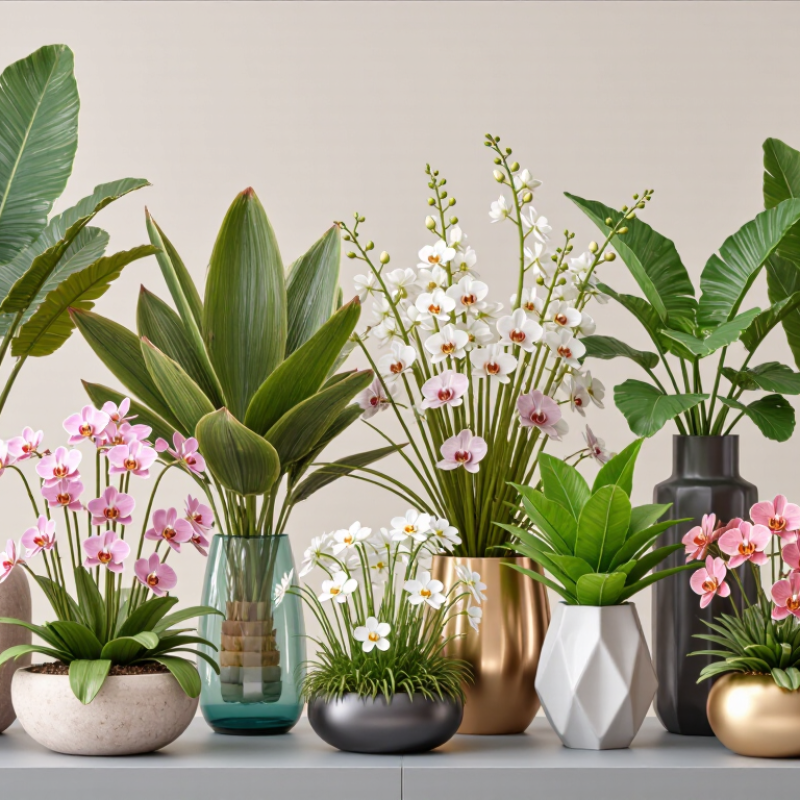
What Are Faux Botanical Arrangements and Why Are They Popular?
Faux botanical arrangements combine artificial flowers, leaves, and branches into decorative displays. They may use silk, polyester, plastic, or other materials, with wired stems that can be shaped by hand. A well-made arrangement often includes varied leaf sizes, natural-looking color shifts, and stems placed at different heights. From across a room, these details can create a convincing sense of depth. Up close, some materials still look too glossy. That limitation is worth considering.
Their popularity comes from practical benefits. They do not need watering, sunlight, or regular trimming, making them useful in offices, shaded hallways, and busy homes. They also stay in place through changing seasons, while fresh flowers may wilt within days. For people sensitive to pollen, some arrangements can be a convenient alternative, though dust may collect on the leaves. Not maintenance-free, exactly.
Tips: Check the arrangement from several angles before buying. Look for securely attached petals, flexible stems, and a stable base. Match its scale to the room: a tall branch can suit an entryway, while a compact arrangement fits a bedside table. Dust it gently with a soft cloth every few weeks, and keep it away from prolonged direct sunlight to reduce fading.
How to Evaluate China’s Faux Botanical Arrangement Suppliers
How to Evaluate China’s Faux Botanical Arrangement Suppliers
China’s faux botanical arrangement suppliers should be assessed on consistency, materials, and production evidence—not catalogue photos alone. Grand View Research estimated the global artificial plants market at about US$1.6 billion in 2023, with continued growth projected through 2030. That market outlook makes supplier capacity relevant, but it does not prove a factory can reproduce your sample. Request a pre-production sample, then compare leaf color, stem thickness, pot finish, and arrangement height against the approved specification. Small differences matter. Ask how the supplier controls color variation between batches and documents incoming materials.
Check production records, export experience, and inspection procedures. ISO 9001 certification can indicate a documented quality-management system, but it is not a product-quality guarantee. Ask for recent inspection reports and define acceptance criteria for loose leaves, visible glue, crushed stems, and packaging damage. For larger orders, consider an independent pre-shipment inspection using an agreed sampling plan, such as ISO 2859-1. Confirm carton dimensions and packing methods with a trial shipment; delicate branches can arrive bent even when the sample looked excellent. Be cautious with unusually low quotations. I have found that comparing only unit prices misses rework, packaging, and communication costs. A clear specification and honest follow-up are worth more than polished promises.
China’s Top 10 Faux Botanical Arrangement Suppliers
China’s Top 10 Faux Botanical Arrangement Suppliers reflect a growing decorative market. Grand View Research valued the global artificial flowers market at about USD 1.8 billion in 2023. It also projects steady growth through 2030. This demand supports suppliers making silk flowers, preserved-style stems, moss, branches, and complete table arrangements.
The ten suppliers in this category should be assessed beyond catalog photos. Strong candidates usually provide stable color batches, reinforced stems, clean-cut foliage, and protective export packaging. Their factories should explain fiber content, flame behavior, odor control, and quality inspection procedures. Intertek and SGS industry testing services commonly evaluate materials, heavy metals, and product safety. Ask for current reports, not screenshots. Details matter.
A practical comparison should review sample accuracy, minimum order quantities, production lead times, and replacement policies. The China Chamber of Commerce for Import and Export of Light Industrial Products and Arts-Crafts has repeatedly highlighted customization and flexible manufacturing as competitive strengths in decorative goods. Yet flexibility can create inconsistency. A supplier may produce beautiful samples but weaker bulk orders. That risk deserves scrutiny. Buyers should request pre-shipment inspections, carton photos, and batch records before approving large volumes. Sustainable claims also need evidence, especially when suppliers mention recycled plastics or reduced packaging. The top ten should therefore be viewed as a starting point, not a permanent ranking. Market data changes, and supplier performance can change faster.
How the Leading Suppliers Compare by Products and Services
Comparing China’s leading faux botanical arrangement suppliers means looking beyond catalog size. Product range matters: buyers may need single stems, ready-made centerpieces, preserved-look foliage, or custom trees for hotel lobbies. Check leaf color under warm lighting, stem wire strength, pot finish, and whether arrangements arrive assembled. Small details show up fast.
Fortune Business Insights estimated the global artificial plants market at about US$1.64 billion in 2023, forecasting US$2.34 billion by 2032. This is a market forecast, not a ranking of Chinese suppliers. Still, it suggests demand for realistic, durable products is worth tracking. Compare suppliers on sample consistency, customization, packaging protection, and documented lead times. Ask for close-up photos and a physical sample; screen images can hide rough seams. Useful, but imperfect.
Service differences can matter as much as foliage quality. Some suppliers offer design drawings, custom dimensions, and mixed-SKU orders; others focus on standard products and larger minimum quantities. Request material specifications, carton dimensions, and replacement terms in writing. Clarify who handles freight coordination and export documents. A polished sample is not proof that every production batch will match. Ask how quality checks are recorded, and whether color variation is accepted. That answer can be revealing.
China Faux Botanical Suppliers: A Buyer’s Evaluation Framework
Suggested evaluation weights for comparing suppliers by product range and service. These are buyer-planning priorities, not measured supplier ratings or market statistics.
Product quality and customization receive the greatest emphasis, while lead time, communication, and sustainability help complete a balanced comparison. Adjust the weights to match your sourcing requirements.
How to Choose the Right Supplier for Your Business Needs
Choosing among China’s top faux botanical arrangement suppliers starts with your actual use case. A hotel lobby needs dense, UV-stable foliage; a boutique may value delicate color matching and smaller order quantities. Ask for close-up photos, material specifications, sample lead times, and packaging details. Small details matter. Check how stems are wired, whether leaves shed under gentle handling, and how arrangements look after shipping. A polished catalog is not proof of consistent production.
Compare suppliers on more than price. Request a written quotation that separates sample, tooling, packaging, and freight costs. Ask how defects are recorded and replacements handled. Grand View Research’s Artificial Plants Market report forecasts 5.9% compound annual growth from 2024 to 2030, suggesting continued category demand. That growth does not guarantee reliable quality. A clear sample approval process and repeatable color standards are more useful than broad promises.
For larger orders, request a pre-shipment inspection and agree on measurable acceptance criteria, such as arrangement height, color variation, and carton protection. Confirm production capacity during peak seasons, not only in a sales call. Keep a buffer for revisions. I have seen buyers overlook this; it can be an expensive lesson. A supplier that answers specific questions plainly is often a safer fit than one offering the lowest quote.
FAQS
They combine artificial flowers, leaves, and branches into decorative displays. Wired stems can often be shaped by hand.
They need no watering, sunlight, or trimming. They also stay colorful longer than fresh flowers, which may wilt within days.
Yes. Dust leaves gently with a soft cloth every few weeks. Keep arrangements away from prolonged direct sunlight to reduce fading.
Check for varied leaf sizes, subtle color changes, and stems at different heights. Some materials look glossy up close. That can disappoint.
Match its size to the space. A tall branch may suit an entryway, while a compact display fits a bedside table.
Request a pre-production sample and compare leaf color, stem thickness, pot finish, and height with your written specifications. Photos are not enough.
No. Certification may show that quality procedures are documented, but it does not guarantee the finished arrangement will meet your expectations.
Define acceptable defects, such as loose leaves or crushed stems, and review recent inspection records. Test carton dimensions and packing with a trial shipment. Branches bend. Compare the full cost, not only the unit price.
Conclusion
This guide explores Faux Botanical Arrangements, including what they are, how they differ from fresh or preserved plants, and why they are increasingly popular for homes, hotels, offices, events, and retail spaces. Their realistic appearance, low maintenance, long service life, and flexible design options make them a practical choice for businesses seeking attractive décor without regular watering, replacement, or specialized care.
The article also explains how to evaluate suppliers in China by examining product quality, material safety, craftsmanship, customization capabilities, production capacity, packaging, pricing, communication, and delivery reliability. It presents a comparison of ten leading supplier types based on their product ranges and services, such as artificial flowers, greenery, decorative containers, made-to-order displays, and project support. Finally, the guide offers a practical framework for selecting the right supplier according to budget, design requirements, order volume, target market, and long-term cooperation goals.

 Senmao garden